
How To Fix a Garage Door That Reverses As Soon as It Closes
Reasons Why Your Garage Start to Close Then Reverses
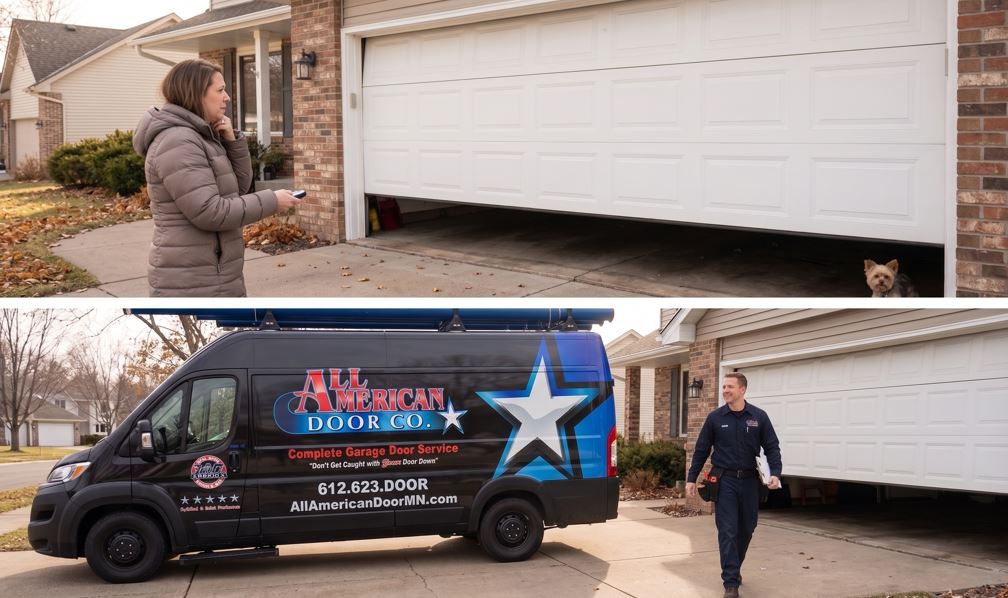
When your garage door closes, touches the ground, and immediately pops back up like a toaster, it is performing a Safety Reversal.
The opener’s logic board is programmed to protect anything in its path. If it feels even a fraction of an inch of extra resistance or perceives that it hasn’t reached its final destination yet, it assumes it hit a person or a pet and retreats.
To fix this, we need to look at the three pillars of garage door operation:
- Sight (Sensors)
- Space (Limits)
- Strength (Force)
1. The Seasonal Threshold Shift
Most guides tell you to clean your sensors, but in Minnesota, we deal with Threshold Heave. Because our frost line is so deep, the concrete slab of your garage floor actually expands and contracts between February and July.
If you set your door’s Down Travel in the summer, the winter frost might have heaved your concrete up by half an inch. Now, the door hits the floor sooner than the opener expects.
The opener thinks, “I haven’t reached my ‘stop’ point yet, but I’ve hit something hard—Emergency Reverse!”
The Fix: You likely don’t have a broken door; you have a door that needs a Seasonal Limit Reset. You’ll need to adjust the Down Travel screw on the motor head (usually turning it a quarter-turn toward the “minus” or “up” direction) to tell the door that the floor is now slightly higher than it used to be.
2. The Photo-Eye Flicker
The two small sensors at the bottom of your tracks must see each other perfectly. In Minneapolis, these are magnets for salt spray, slush, and spider webs.
-
Look at the LEDs on the sensors. One is usually green (receiving) and one is amber (sending). If the green light is flickering or out, the beam is broken.
Pro Tip: Use a damp microfiber cloth to wipe the lenses. Even a thin film of dried salt from your car’s tires can distort the infrared beam enough to trigger a reversal just as the door’s vibration shakes the tracks during closing.
3. Travel Limits vs. Force Settings
It’s important to understand the difference here to avoid damaging your motor:
-
Travel Limits: Define the distance the door moves. If the door reverses after touching the floor, your Down Travel is too long.
-
Force Settings: Define the amount of power used. If the door reverses before touching the floor (mid-air), your Close Force is too low, often because cold weather has thickened the grease in your tracks, making the door harder to move.
The Paper Towel Safety Test
To ensure your door is truly fixed and safe, perform the UL 325 safety test. Place a roll of paper towels (or a 2×4 flat) on the ground. When the door hits it, it should reverse immediately. If it crushes the object, your force settings are too high, which can lead to a cracked bottom panel or a burnt-out motor.
To keep your garage door running smoothly, keep these entities in mind:
-
Weatherstripping: Ensure your bottom seal hasn’t frozen to the ice. If the seal is stuck to the ground, the opener will feel that resistance and reverse.
-
Torsion Springs: If your door is reversing, it might be because a spring is starting to lose tension, making the door heavy and triggering the force sensor.
-
Lithium-Based Grease: Avoid WD-40. Use a silicone or lithium-based lubricant that won’t thicken in a Minnesota January.
When to Call All American Door
If you’ve adjusted your limits and cleaned your sensors but the door still won’t stay shut, the issue may be a stripped nylon gear inside the motor or a warped track.
At All American Door, we specialize in the unique challenges Minneapolis weather puts on residential garage systems. We don’t just fix the symptom; we calibrate your door for the specific seasonal shifts of the North.
Don’t let a rebound door leave your garage open tonight.
Call All American Door at (763) 244–1605 to get your garage door fixed the same day (today) or contact us online with any questions.